
It has a dramatic name, an unmistakable appearance and an appetite that can make a serious difference to a coral reef. Meet the Crown-of-Thorns Starfish, one of the most fascinating — and misunderstood — inhabitants of tropical coral reefs. And first things first: it isn’t a fish at all! Like other starfish, it is an echinoderm, related to sea urchins and sea cucumbers.
The name comes from the animal’s appearance. Its body and numerous arms are covered in long, sharp spines, giving it the look of a rather intimidating underwater crown.
Depending on the species and region, Crown-of-Thorns Starfish can become very large — some individuals can reach around 80 cm in diameter. Their spines are not just for decoration either: they provide an effective defence against predators and contain toxins that can cause severe pain if they pierce human skin.
So, divers: look, don’t touch!
Their colours can vary considerably, and their camouflage can make them surprisingly difficult to spot during a dive. They often hide beneath ledges or in reef crevices, making a close encounter feel like discovering a secret resident of the reef.
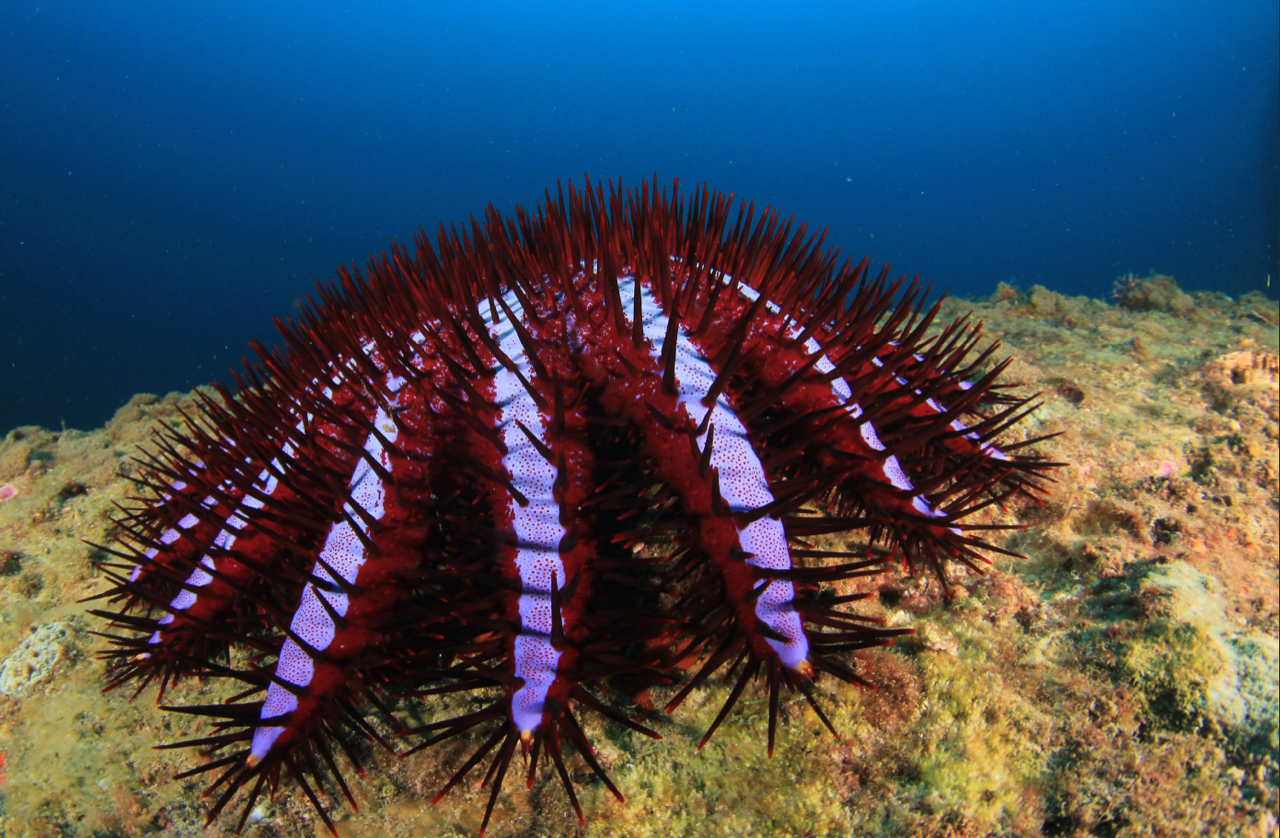
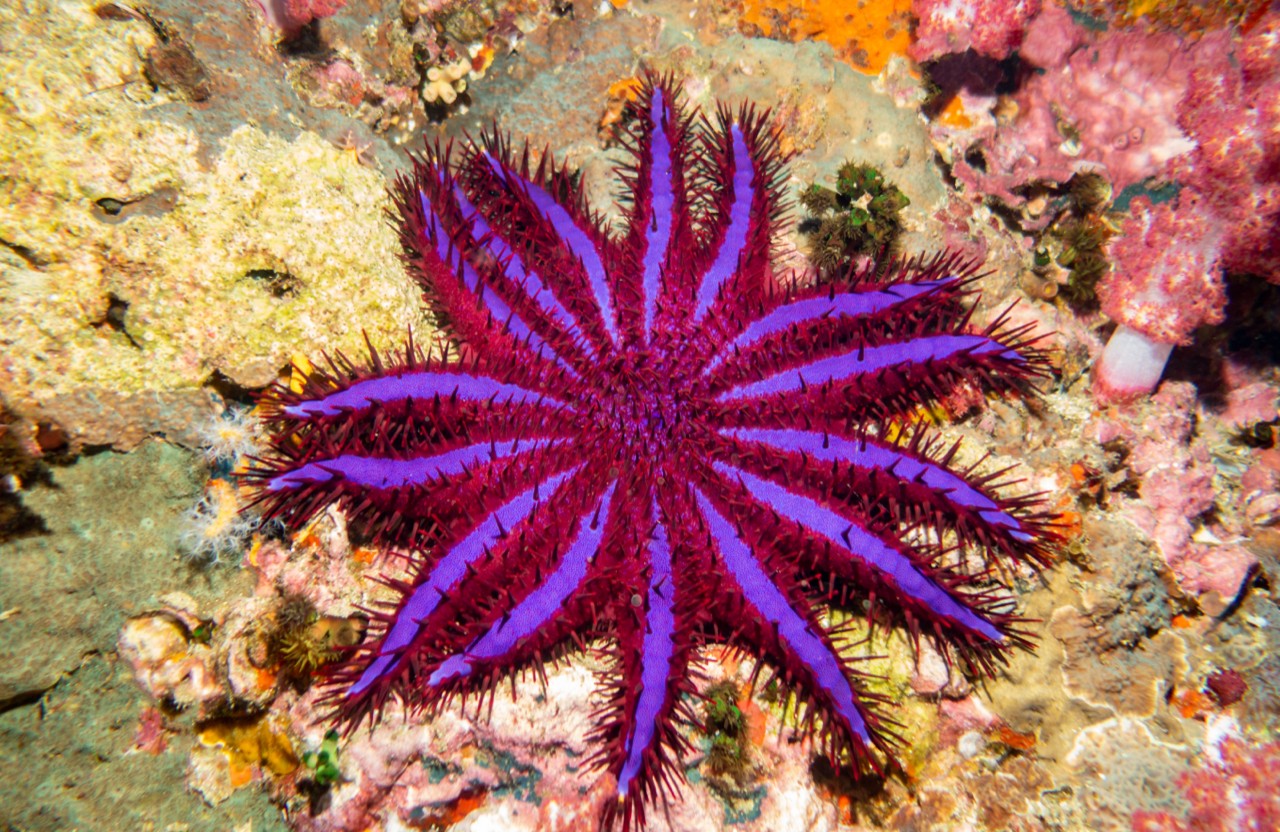
The Crown-of-Thorns has one favourite item on the menu: hard coral.
Unlike grazing fish that scrape algae from the reef, this starfish feeds directly on living coral tissue. It moves across a coral colony, attaches itself and pushes its stomach out over the coral. Digestive enzymes then break down the coral tissue, which the starfish absorbs before pulling its stomach back inside.
What is left behind?
Often, a striking white patch of exposed coral skeleton.
Some of its preferred prey includes fast-growing corals, particularly branching and plate-forming Acropora species. And this little creature has quite an appetite: an adult can consume up to approximately 10 square metres of coral in a year.
This is where the story becomes more complicated.
Crown-of-Thorns Starfish are a natural part of coral reef ecosystems. At normal densities, their feeding can be part of the natural dynamics of a reef and may contribute to coral diversity by preventing a few fast-growing coral species from completely dominating available space.
The problem comes when their population increases dramatically.
During a major Crown-of-Thorns outbreak, thousands of starfish can gather on a reef and consume coral much faster than the reef can recover. Large outbreaks have caused extensive coral loss in different parts of the Indo-Pacific.
When large areas of living coral disappear, the effects go beyond the coral itself. The structure of the reef can change, algae can colonise newly exposed surfaces, and fish communities that depend on living coral habitat can also be affected.
One of the most remarkable things about these starfish is their reproductive potential.
During spawning, males and females release sperm and eggs into the water, where fertilisation takes place. A large female can release more than 200 million eggs in a year. The resulting larvae spend roughly 10–30 days drifting in the plankton before settling and transforming into tiny juvenile starfish.
Young Crown-of-Thorns Starfish don’t immediately start devouring coral. At first, juveniles are tiny and cryptic, feeding mainly on crustose coralline algae. Within months they develop into their adult form, begin feeding on coral and can reach sexual maturity in around two years.
That enormous reproductive potential helps explain why population explosions can happen under the right conditions.
With those impressive spines and toxins, you might think nothing would dare take on a Crown-of-Thorns.
But nature always has a few surprises.
Predators include the giant triton snail, as well as some fish and other reef predators.
The balance between Crown-of-Thorns and its predators is one of the factors scientists consider when studying population outbreaks. Other environmental factors, including conditions affecting their larval food supply, have also been investigated as possible contributors to outbreaks. There isn’t one simple explanation that applies to every outbreak.
Crown-of-Thorns Starfish can be found throughout the Maldives, so you may well encounter one on your next dive. If you spot one — or especially several together — let your dive instructor or guide know. They can keep an eye on the situation and assess whether further action is needed.
This is one reef resident you should never handle.
The spines are extremely sharp and can inject toxins when they penetrate the skin, causing intense pain and other symptoms. Even a seemingly harmless attempt to move one can result in a nasty injury.
The best approach underwater is simple:
Look. Admire. Photograph. Keep your hands to yourself.
The Crown-of-Thorns Starfish is a perfect example of the complexity of coral reef ecosystems.
At normal numbers, it is simply another part of the reef. When conditions allow its population to explode, however, its extraordinary appetite can become a major pressure on coral communities.
So the next time you see one on a dive, take a moment to appreciate what you’re looking at. Behind those strange colours, countless arms and impressive spines is an animal with a fascinating life cycle, remarkable survival strategies and a very important — if sometimes controversial — role in the reef ecosystem.


