
Just a rock.
Rough, still, unremarkable.
And that’s exactly the point.
The stonefish is one of the most fascinating—and misunderstood—creatures you can encounter while diving in the Maldives. Master of disguise, it rests motionless on sandy bottoms or coral rubble, blending so perfectly into its surroundings that even experienced divers can swim right past it without ever noticing.
Until suddenly… you do.
In the warm, shallow waters of the Maldives, stonefish are part of the reef’s silent life. They prefer calm lagoons, reef flats, and sandy patches between coral formations—places divers and snorkelers often explore.
But unlike the vibrant fish flashing colors all around, the stonefish plays a different game: invisibility.
Its body mimics texture, color, even the irregular shape of coral rock. Algae often grow on its skin, completing the illusion. It doesn’t chase, it doesn’t flee—it simply waits.
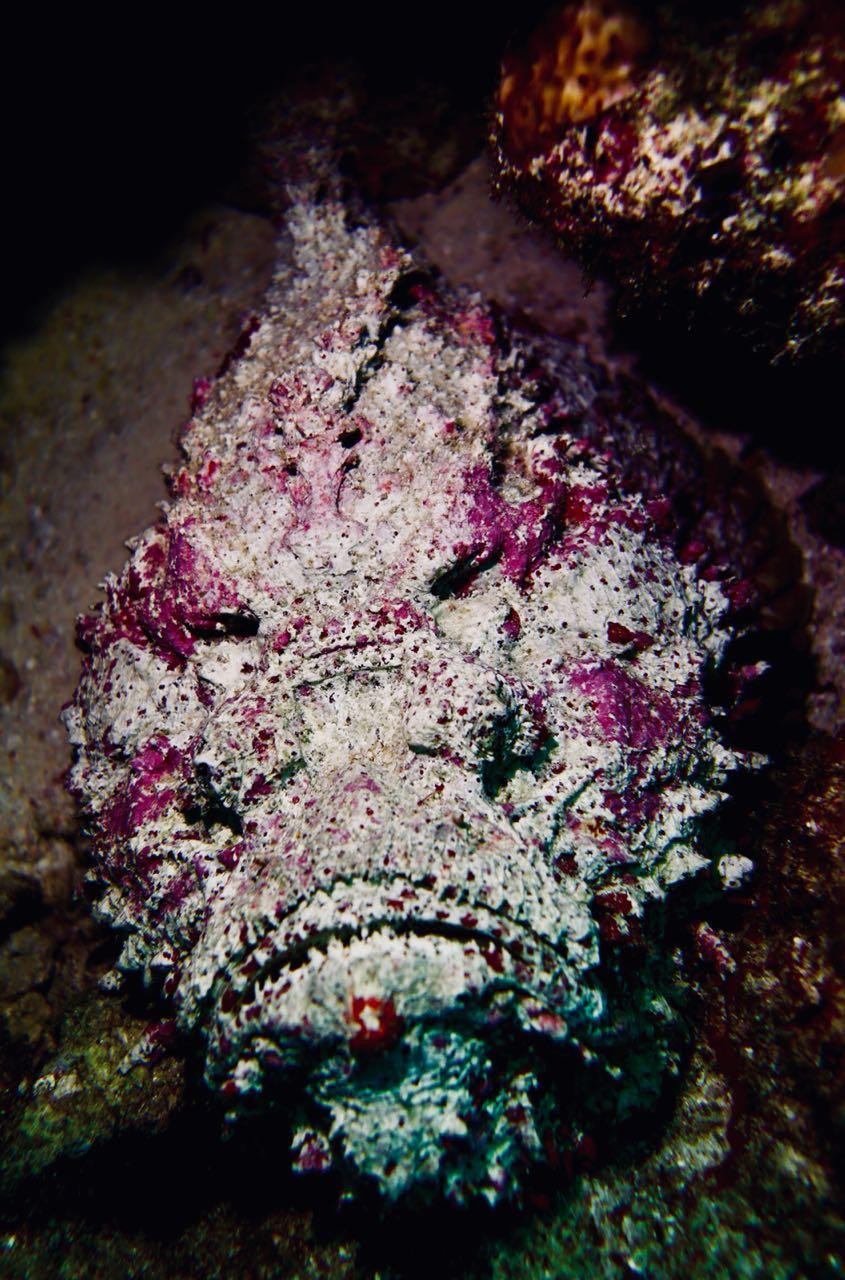
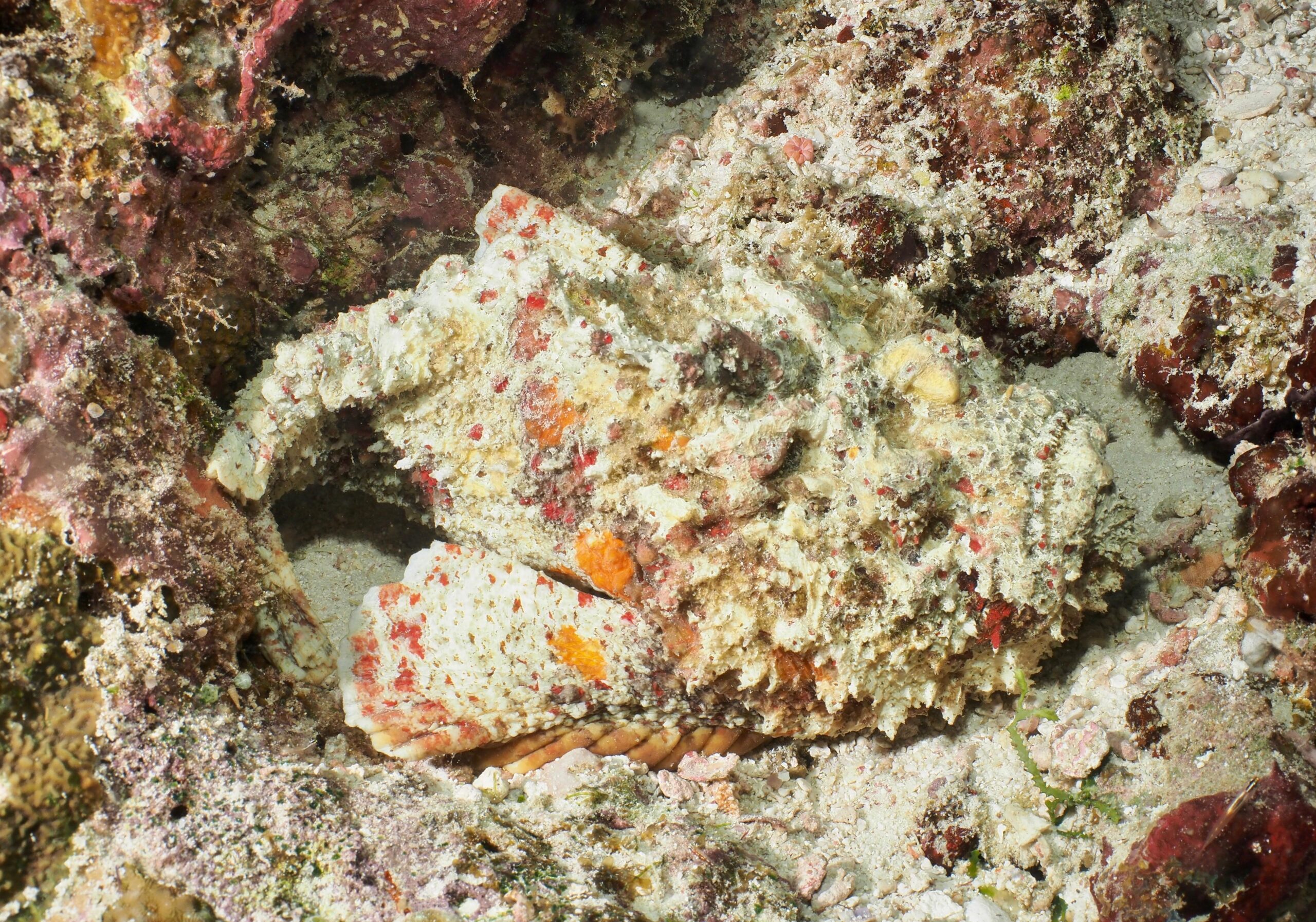
Here’s the twist: the stonefish is considered the most venomous fish in the ocean.
Along its back are 13 dorsal spines, each capable of injecting powerful venom if stepped on or pressed. This isn’t aggression—it’s defense. The stonefish doesn’t attack; it reacts only when disturbed.
For divers, this makes awareness key. Good buoyancy and respectful distance are more than enough to safely coexist with this incredible animal.
Despite its stillness, the stonefish is an efficient hunter.
When prey comes close—small fish or crustaceans—it strikes in a fraction of a second, using suction to swallow it whole. The movement is so fast it’s almost invisible, a sudden shift in what moments before looked like a lifeless rock.
It’s one of the ocean’s best examples of ambush predation.
It’s easy to label the stonefish as dangerous. But in truth, it’s something else entirely:
a masterpiece of evolution, patience, and adaptation.
A creature that survives not through strength or speed—but through stillness.
And in a place like the Maldives, where life moves both fast and slow at the same time, it feels strangely fitting.
Seeing a stonefish in the Maldives is never guaranteed—but that’s part of the magic. It’s not a big, dramatic encounter like a manta or a shark. It’s quieter, more subtle. A moment of realization. A second look at the reef. A reminder that the ocean hides stories in plain sight.
With Divepoint Maldives, guides know where to look—and more importantly, how to help you see what others miss.
Photo by Marcus Hauck


