
Photo by Mika d’Eau
Meet Miamira sinuata, a fascinating nudibranch with a rather impressive nickname, an unusual appearance and a story that reminds us why it’s worth looking closely at the underwater world.
Imagine swimming along a reef when something catches your eye: a bright green, bumpy creature slowly making its way across the reef. At first glance, you might mistake it for a strange piece of coral or an unusual underwater plant. Look a little closer and you may have discovered one of the ocean’s most fascinating little residents: Miamira sinuata, better known as the Jolly Green Giant!
Despite its impressive nickname, this colourful character is a sea slug belonging to the nudibranch group. It may not be very large, but it certainly knows how to stand out!
One of the most striking features of Miamira sinuata is its wonderfully textured body. Its back is covered with rounded bumps, known as tubercles, while the edges of its body form a wavy, almost scalloped outline.
Its colours can vary considerably. Some individuals are a vivid, bright green, while others appear purplish brown or reddish. The rounded bumps can contrast with the body’s main colour, and small white spots may be visible on its rhinophores and gills.
So, although the Jolly Green Giant is famous for its green appearance, not every individual looks the same. Nature certainly enjoys keeping us guessing!
Its scientific name is interesting too: sinuata refers to a wavy or curved outline, a fitting description of its distinctive body margins.

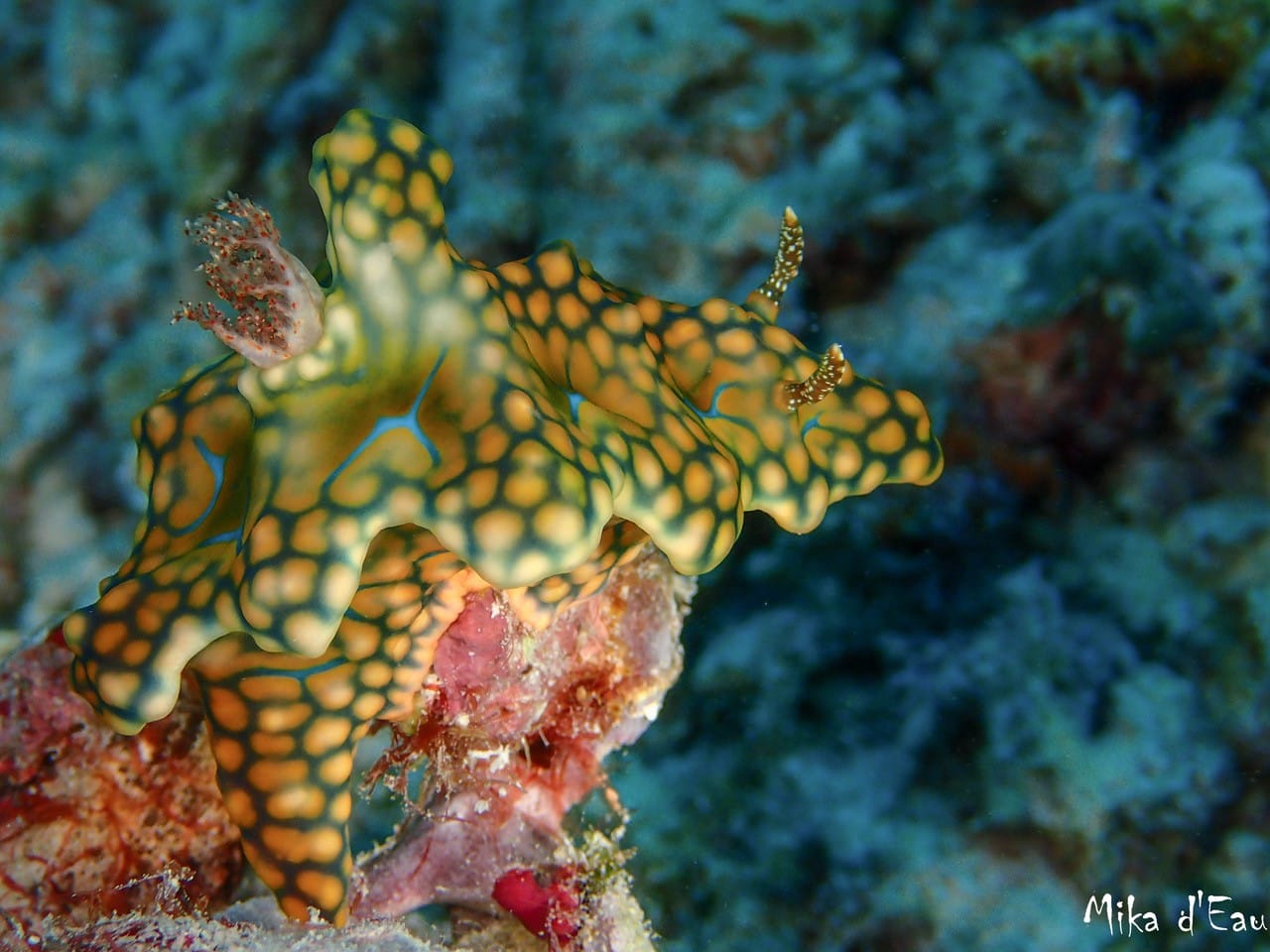
Photo by Mika d’Eau
Miamira sinuata is found across the Indo-West Pacific, with recorded sightings in the Maldives, Indonesia, the Solomon Islands, Hawaii, Japan and Australia, among other locations.
It lives on rocky and coral reef habitats, often close to the reef surface, and has been recorded from shallow water down to around 25 metres in some locations. This means it can be found at depths accessible to recreational divers — although spotting one is another story!
Like many small reef creatures, it can be easy to overlook if you’re swimming too quickly. A slow dive and a curious eye can make all the difference.
Here’s another fascinating detail: Miamira sinuata feeds on marine sponges.
Sponges may not look particularly exciting at first glance, but they are important members of reef ecosystems. They filter water, recycle nutrients and provide shelter for other marine organisms.
Nudibranchs are often very selective eaters. Different species feed on different organisms, including sponges, hydroids, anemones and even other sea slugs. Their diets are closely connected to the habitats in which they live.
This is a lovely reminder that a reef is not simply a collection of colorful fish and corals. It is a complex community in which even the smallest creatures have their own role.
Nudibranchs are famous for their extraordinary colours and shapes, but their real magic lies in their incredible diversity.
Different species have developed fascinating ways to protect themselves. Some can retain stinging cells from the organisms they eat, others use chemical defences, while some rely on camouflage to blend into their surroundings. In certain species, bright colours can even act as a warning to potential predators.
However, not all nudibranchs use the same strategies, and the specific defensive mechanisms of Miamira sinuata are not as well documented as its appearance and diet.
And here’s one more little curiosity: if you search for this species, you might come across its former scientific name, Ceratosoma sinuatum. Scientific classification changes as researchers discover more about how different species are related. Its currently accepted name is Miamira sinuata.

There is much more to learn about these incredible sea slugs and SSI just released a Nudibranch Ecology Specialty which will explain everything you ever wanted to know about Nudibranchs!
Because sometimes, the best part of a dive isn’t finding the biggest animal — it’s learning to recognise the smallest wonders.


