
When divers dream about the Maldives, they often imagine graceful manta rays, majestic whale sharks or colourful coral reefs. But some of the reef’s most fascinating stories are hidden in plain sight—just a few centimetres above the sand.
Meet the Watchman Goby and the Pistol Shrimp, one of the ocean’s most extraordinary examples of teamwork. Although they belong to completely different groups of animals, these two have evolved into inseparable partners. Scientists call this relationship mutualistic symbiosis, meaning both species benefit from living together.
The Pistol Shrimp is a tireless engineer. Using its powerful legs, it spends hours excavating tunnels and chambers beneath the sand, creating an elaborate burrow that provides shelter from predators, strong currents and rough weather.
However, there’s one problem.The shrimp is almost blind. Without help, it would be an easy meal for passing predators. Fortunately, it has recruited the perfect security guard.
The Watchman Goby positions itself at the entrance of the burrow, constantly watching the surroundings. Throughout the day, the shrimp maintains physical contact by gently resting one antenna against the Goby’s body or tail.
As long as the Goby remains relaxed, the shrimp knows it is safe to continue digging.
The instant the Goby detects danger, it gives a rapid tail flick. Without hesitation, both animals disappear underground. This silent communication has become so refined that the two partners function almost as a single organism.
Despite its poor eyesight, the Pistol Shrimp is far from defenceless. Its enlarged snapping claw closes at speeds of over 100 km/h, creating a collapsing cavitation bubble that reaches temperatures of nearly 4,000°C for a fraction of a second.
The tiny underwater “explosion” generates a loud pop that can stun or even kill small prey before the shrimp moves in for its meal. It’s one of the fastest movements recorded in the animal kingdom.
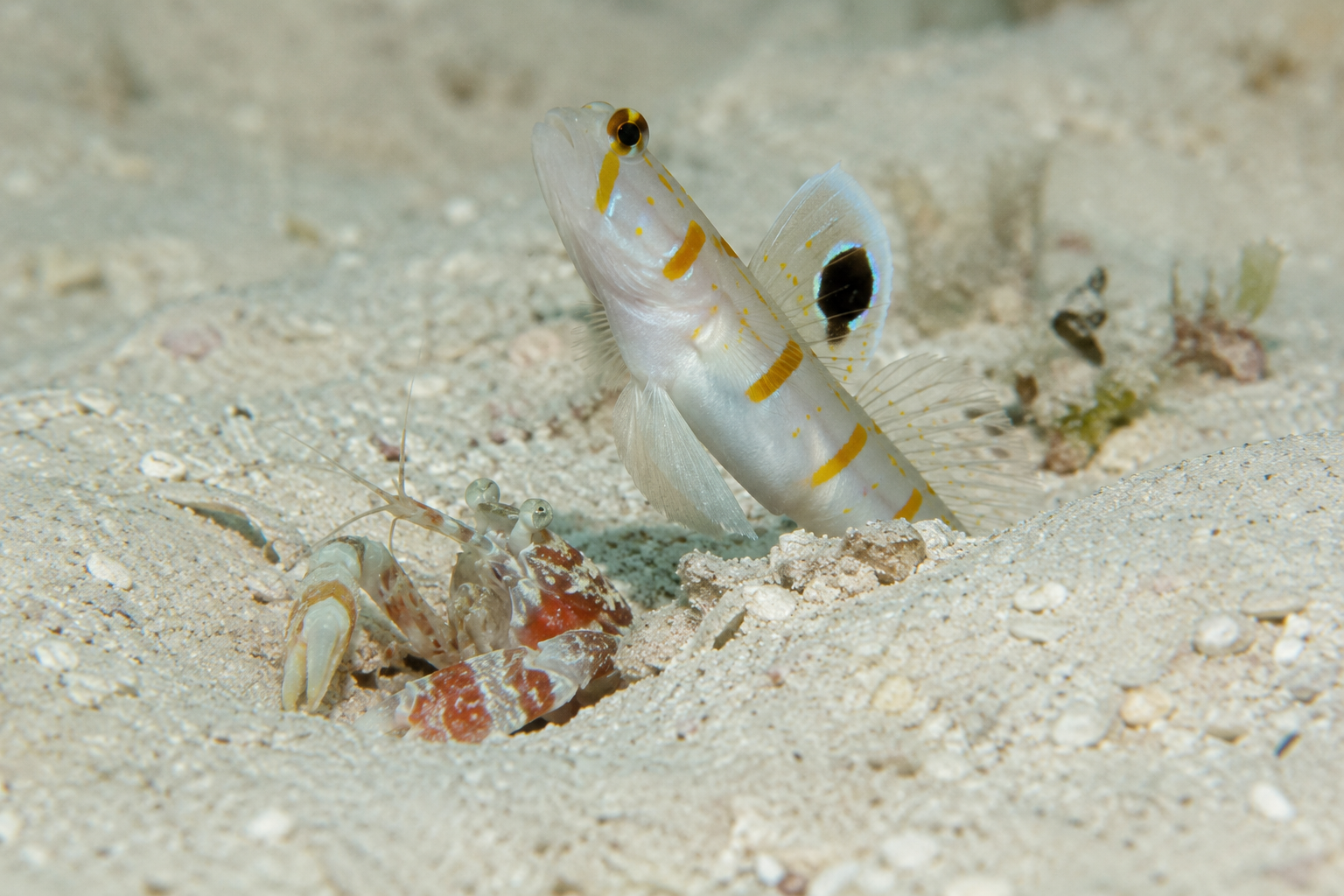
Most Goby-Shrimp pairs remain together for long periods, often sharing the same burrow for months or even years. During the breeding season, the female Goby lays adhesive eggs inside the burrow, where the male carefully guards and fans them until they hatch. Once the larvae emerge, they drift away with the currents before eventually settling onto the seabed to begin life—and hopefully find a shrimp partner of their own.
The shrimp also reproduces by releasing larvae into the open water, meaning every successful partnership begins with two tiny animals somehow finding each other among thousands of square metres of reef.
• There are over 600 species of Pistol Shrimps worldwide.
• More than 120 Goby species live in partnership with them.
• The Pistol Shrimp’s claw is one of the fastest biological movements ever recorded.
• The Goby acts as the shrimp’s eyes, while the shrimp provides the Goby with a safe home.
• One of the best places to observe this fascinating relationship is right here in the Maldives—especially on the sandy reefs around Meedhupparu, where our Divepoint guides regularly introduce guests to these tiny “partners in crime.”
More than 120 species of Gobies are known to form partnerships with around 20 species of Pistol Shrimps, making this one of the most successful symbiotic relationships in tropical oceans.
They are commonly found throughout the Indian and Pacific Oceans, living on sandy bottoms adjacent to coral reefs.
In the Maldives, you’ll usually spot them between 3 and 35 metres, especially:
• Sandy reef slopes
• Coral rubble areas
• Lagoon entrances
• Gentle reef drop-offs
The sandy reefs around Meedhupparu, as well as all Divepoint dive centres across the Maldives, are home to several species of Gobies and Pistol Shrimps.
The challenge isn’t whether they’re there…It’s whether you notice them.
Luckily, our guides spend hundreds of hours underwater every year and have developed an eye for spotting the smallest reef inhabitants. While most divers swim right past these fascinating little neighbours, our guides know exactly where to look—and they’re always excited to share these hidden treasures with our guests.
So next time you’re diving, don’t just search the blue for manta rays or sharks.
Slow down. Look closely at the sand.
You might just witness one of nature’s greatest partnerships unfolding before your eyes.


